
Poverty Is a Health Issue, Not a Side Issue
Poverty in Canada isn't just about income — it's structured, predictable, and it shapes who gets sick, who ages into hardship, and who can't get care when they need it.

For a fuller discussion of how we overspend on medicine compared to other government functions, see [Where Do Our Tax Dollars Go?]
One of the most important downstream factors in predicting death, disease and disability is poverty.
But poverty in Canada isn’t just about income. It isn’t even only about individuals having enough of the material things... it is about the organization, culture and well-being of communities and individuals within them.
Repeated research demonstrates the people living on lower incomes face shorter life expectancies. They confront more illness, disability, accidents and suicide. Poorer people also suffer the daily stressors of trying to make ends meet. This stress can increase mental health challenges. Poverty isn’t a chance occurrence. It’s structured. It’s predictable.
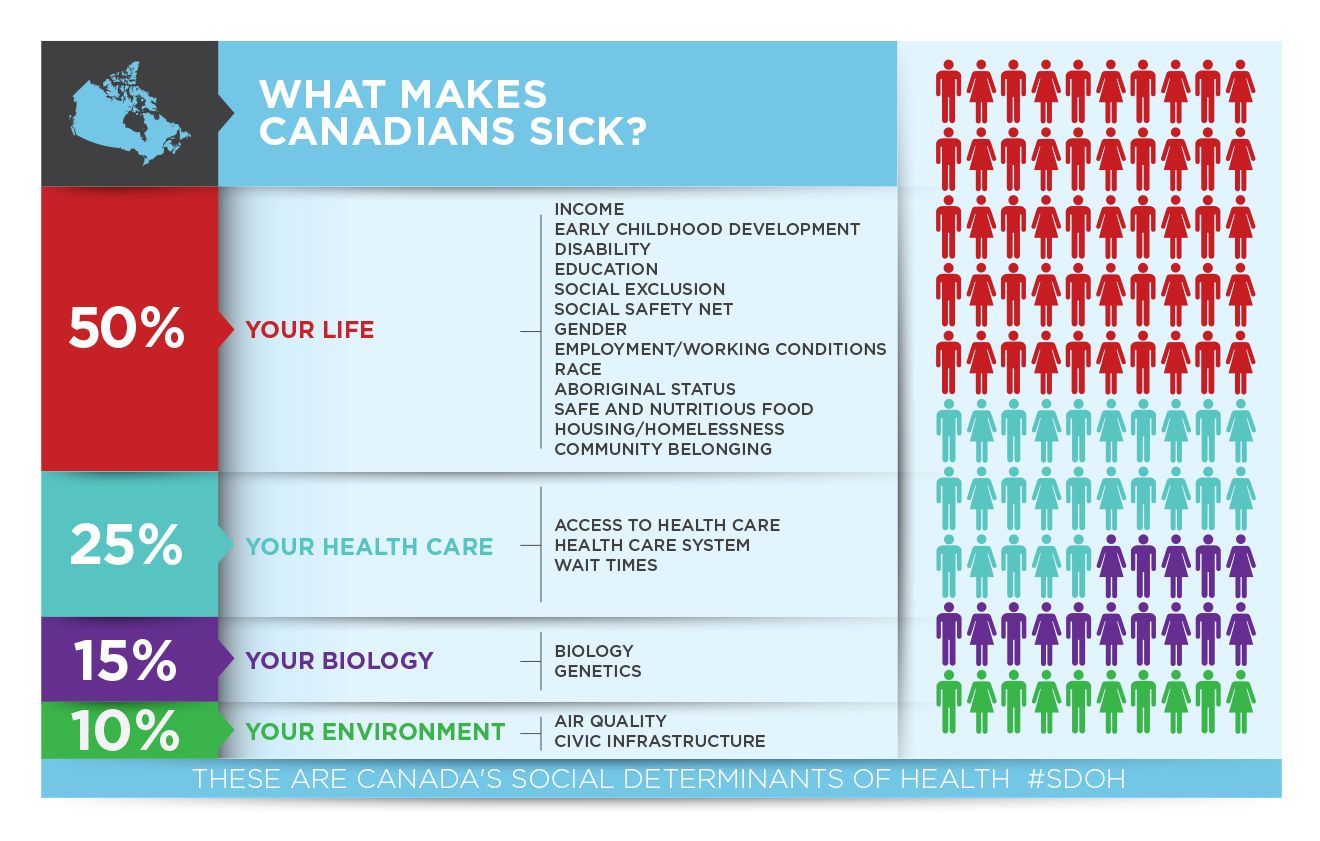
For example, poorer people tend to lack reliable access to sufficient nutritious food, adequate and stable housing, safe streets and sufficiently available, secure and rewarded work. These issues heighten challenges to all aspects of their lives.
Food Insecurity
Food insecurity is one of the clearest — and most troubling — examples of this inequity. About one-quarter of Canadian households struggle to afford enough food, or a sufficient variety of it. That’s not a marginal issue — it’s a systemic one. In March 2026 alone, 2.2 million Canadians used foodbanks, underscoring just how persistent and widespread the problem has become.
Food insecurity disproportionately impacts Northern and remote communities, families relying on government benefits, and single-parent households. These are not random or isolated pockets but are foreseeable outcomes of broader social and economic policies.
Children and Elders
And there are specific groups of people in Canada who are structurally disadvantaged. Let’s look at children and elders for a moment.
Child poverty in Canada remains stubbornly high — higher, in fact, than in comparable countries like the United Kingdom, Germany, and France. That’s a reflection of our policy choices and priorities.
The impact of children growing up in poverty is profound and long-lasting. It shapes everything from educational outcomes to physical and mental health. It increases the likelihood of social exclusion later in life. In other words, poverty in childhood doesn’t stay in childhood — it follows people across their lifespan.
If we’re serious about breaking this cycle, the evidence is clear: we have to start early. Interventions in childhood are compassionate and they’re more effective than later intervention.
They lead to longer and healthier lives. Investments like child benefits, accessible early education and childcare don’t just provide short-term relief — they create the conditions for long-term stability and opportunity.
Turning to the other end of the age spectrum — retirement doesn’t necessarily mean having the means to live on a good pension. And for those without the benefit of retiring with a pension plan, the monies provided by the government are barely enough to survive. Expenses can change, and change suddenly. An unexpected illness, a rent hike, inflation at the grocery store can exacerbate the underlying financial precarity and throw a person into further impoverishment. This affects single and female seniors, especially. As the Canadian population ages — with the number of seniors expected to reach 10 million by 2036 — these deficits will grow.
Evidence clearly suggests that increasing income supports and enhancing community services and connectivity are essential to ensuring that aging in Canada doesn’t come with increased risk of poverty and declining health.
Barriers to Care
Finally, when medical care is needed, it is not always available to those living in poverty. Although we have a publicly funded and “universal” health care system, access to it is uneven and unequal. Many low-income Canadians face significant barriers to care — out-of-pocket costs, parking and transportation challenges, and the sheer complexity of organizing time off. Getting childcare and time off from inflexible or precarious hourly-waged work, seeking care becomes not just difficult, but sometimes impossible.
What Can and Is Being Done
North Carolina has initiated a programme that diverts Medicaid dollars to provide services to poorer people. These services include, among other things, weekly food delivery, transportation to medical care appointments, and similar types of help. The model has already been successful in lowering the costs of medical care. It has had positive effects for the individuals and families participating in the programme, and it has also provided benefits for the local economy.
There is a programme in New York City which provides a secure and reliable space for people who are unhoused to recuperate once they leave the hospital. St. Michael’s Hospital in downtown Toronto offers a navigator programme and other outreach assistance for unhoused people who are discharged from hospital care.
Another programme based in New York City provides a guaranteed income for unhoused mothers.
What Can You Do
Learn about inequality in your community. Find out what is being done to reduce inequality and what you can do to be part of the solution in your own local area.

Further Reading
- Social Determinants of Health Animation — a short animated explainer on how social determinants shape health.
- Pacific Public Health Foundation, “Visualizing the Social Determinants of Health” — background on SDH imagery, including the CMA’s “What Makes Canadians Sick?” infographic referenced above.